



 2025.10.28 - 2025.10.30
00:00 - 00:00
2025-11-10
Source:https://www.eyeshenzhen.com/content/2025-11/05/content_31754764.htm
The 2025 Carbon Peak and Carbon Neutrality Forum and Shenzhen National Low-Carbon City Forum, held on Oct. 28 at the Shenzhen International Low Carbon City in Longgang District, convened a formidable assembly of Chinese policymakers, leading scientists and engineers, and international experts to address one of the most complex challenges of our time.
Framed around the central theme of “AI Empowering Urban Green Development,” the event was designed not merely to showcase Shenzhen’s achievements, but to “gather global wisdom” and “inject surging momentum” into the urban green transition.
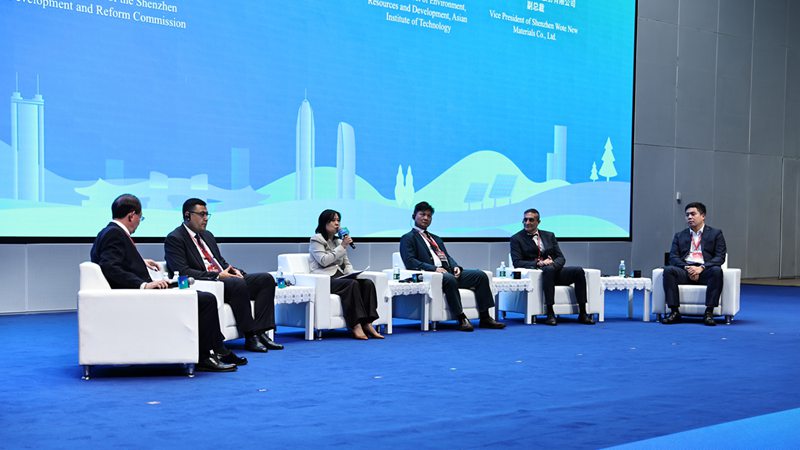
Over two days of intensive speeches and dialogues, a powerful narrative emerged. The forum detailed Shenzhen’s pioneering domestic model for decarbonization, explored the critical technologies — from national grids to advanced materials — that underpin this transition, and culminated in a unified call from global leaders for the international standards and collaboration required to scale local successes into a global solution.
Scaling success: The call for global standards
The forum’s international contingent delivered a unified and powerful message: technology and local ambition are no longer the primary bottlenecks. The most significant barrier to a global green transition is a “consensus crisis” — a lack of the shared standards, policies, and financial rules needed to build trust and unlock investment at scale.
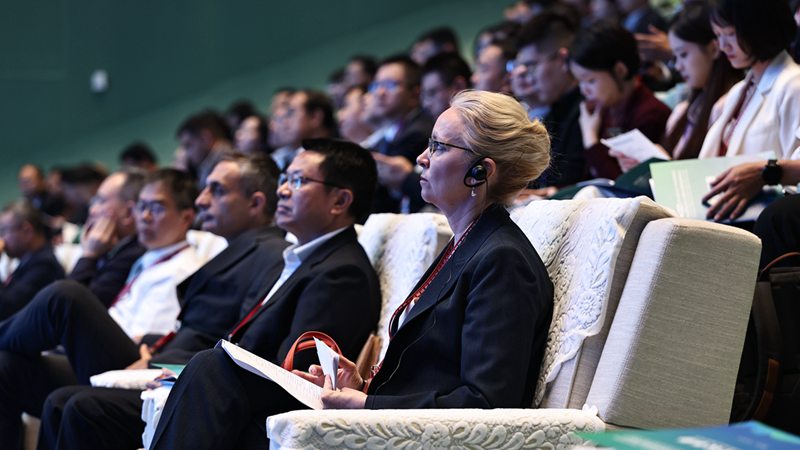

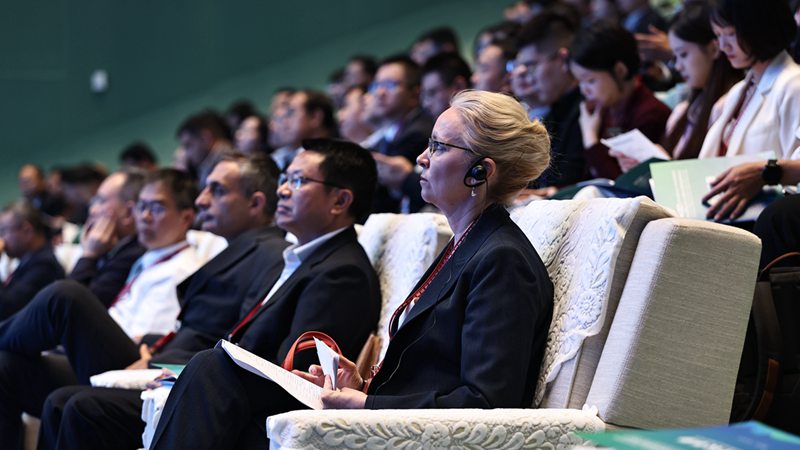
Tatiana Schmollack-Tarasova listens to a speech during the opening ceremony.
Tatiana Schmollack-Tarasova, managing director of the British Standards Institution (BSI) China, framed this challenge most starkly, warning of a “growing maze of different frameworks and reporting requirements” that creates confusion and stalls investment. The antidote, she argued, is trust. “Without trust,” she stated, “we cannot scale success.”
The solution, she argued, is consensus-driven international standards, such as the upcoming ISO standard for Net Zero. She challenged China to take the data from its “living laboratories” like Shenzhen and bring it to global platforms like ISO to help build this essential consensus. For companies lost in the “maze,” her advice was pragmatic: use a “double materiality” principle to focus on the ESG criteria that are most critical both financially and environmentally.
This call for shared rules was powerfully reinforced. Riccardo Mesiano, a senior official at the U.N.’s Economic and Social Commission for Asia and the Pacific (ESCAP), identified a primary barrier as the tendency for governments to treat climate policy as a “separate agenda.” To be effective, he argued, climate goals must be integrated directly into macroeconomic frameworks and industrial policy.
Prof. Vilas Nitivattananon of the Asian Institute of Technology provided a crucial nuance, praising Shenzhen as an excellent model for mega-cities but cautioning that its high-tech, top-down approach must be adapted, not simply copied, for smaller cities that require more “bottom-up” engagement. This underscores the need for a collaborative approach based on shared learning, not just one-way instruction.
The forum’s ultimate message was that collaboration is the only path forward, a point articulated by Janneke de Vries, director of EU partnerships at the WRI. In an era of “geopolitical tensions and fragmented supply chains,” she argued that cooperation on climate and green industry can serve as a crucial “stabilizing bridge.” She pointed specifically to the EU-China Common Ground Taxonomy for sustainable finance as a prime example of this principle in action.
By creating a shared definition of “what counts as genuinely green,” the taxonomy gives investors and companies a “clearer view” and builds confidence and stability in the market. This coordinated policy, de Vries explained, allows the two major economic blocs to actively “reduce uncertainty for global markets,” proving that even in a complex world, shared green standards are not just an environmental goal, but a powerful tool for ensuring global economic stability and progress.